Case Study 02 / 06 · Justworks · 2 months
EOY at
Justworks
End of year is the most stressful time in payroll. Every company had a deadline-driven checklist. My job was to make the highest-stakes period in the payroll calendar feel manageable.

My Role
Design Lead: strategy, research synthesis, IC design, stakeholder alignment
Team
Cross-functional: PM, Payroll Ops, Compliance, Engineering, Content Design
Timeline
2 months
Scope
EOY task flows · Compliance checklists · Admin dashboard surface · Notification system
The most high-stakes deadline in the payroll calendar.
End of year is the most stressful time in payroll. Every company using Justworks had a deadline-driven checklist of compliance tasks: W-2s, ACA forms, contractor 1099s, final payroll reconciliations. And every admin was navigating it through a product that had been built incrementally over years, not designed for the moment when everything was due at once.
My job was to make the most high-stakes period in the payroll calendar feel manageable.
Complexity that the product wasn't designed to handle.
End-of-year compliance for HR and payroll admins is genuinely complex. There are interdependent tasks that must happen in a specific order. Deadlines are non-negotiable and legally consequential. And the admins doing this work are often small business owners or office managers — not payroll specialists.
The existing Justworks experience treated EOY as an extension of the existing product. The result: admins were unsure what they needed to do, in what order, by when. Support ticket volume spiked sharply every November through January. And the anxiety was real — missing a compliance deadline could mean penalties for their company.
The existing experience: EOY tasks embedded in the broader product, without dedicated sequencing or status clarity.
The business needed to reduce that support burden and reduce compliance errors. The users needed confidence that they were on track and wouldn't miss anything critical.
Progressive disclosure at the right moment.
I led design from problem framing through delivery. The core challenge was translating compliance complexity (tasks that varied by company size, plan type, and employee mix) into an experience that felt clear and sequential rather than overwhelming.
My approach centered on the idea of progressive disclosure at the right moment: surface what an admin needs to act on now, give them enough context to act confidently, and don't surface the rest until it's relevant.
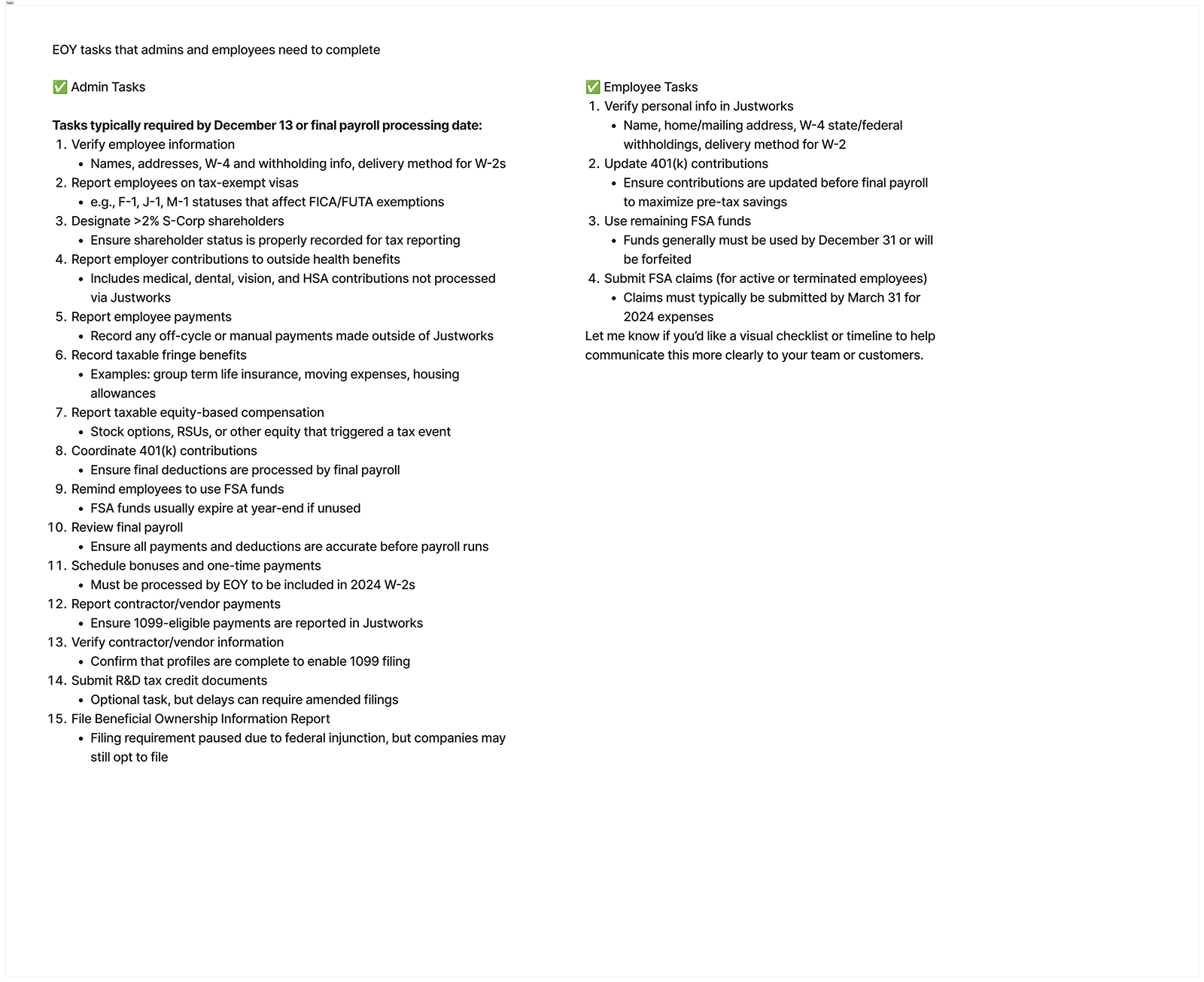
I worked closely with payroll ops and compliance to map the full universe of EOY tasks, then worked with content design and PM to sequence them in a way that matched how admins actually worked through the period — not how the back-end system organized them.


Mapping the full EOY task universe before designing: ensuring sequence matched how admins actually work, not how compliance categorizes it.

Clarity over completeness.
EOY Task Center
The primary design artifact was a dedicated EOY task center: a time-bounded surface that gave admins a clear picture of where they stood: what was complete, what was pending, what was overdue, and what was coming.
Tasks were grouped by phase (preparation, submission, verification) rather than by compliance category, matching the mental model of an admin trying to check things off a list rather than a compliance officer thinking in regulatory buckets.
Each task included: what it is, why it matters, what happens if it's missed, and a clear primary action. No jargon, no assumptions about prior knowledge.
The EOY Task Center: tasks organized by phase to match how admins mentally sequence the work.
Individual Task Design
Each task card was designed to answer the same four questions at a glance: what is this, why does it matter, when is it due, and what do I do next. For admins completing these tasks under real time pressure, clarity at each step was non-negotiable.


Task states: Not Started, In Progress, Submitted, Verified — with explicit visual differentiation and contextual guidance.
Status Clarity & Proactive Communication
A key design principle was eliminating ambiguity about state. We introduced clear status signals: not started, in progress, submitted, verified, with explicit visual differentiation so admins could assess their situation at a glance.
We also worked with the team to build proactive notification logic: surfacing tasks ahead of deadlines, not just when they were already overdue. An admin who gets a reminder two weeks out has options. An admin who gets a reminder two days out has stress.
Confidence where there was anxiety.
Key Results
↓
Meaningful reduction in EOY-related support ticket volume during filing season
↓
Reduced compliance error rates during the EOY filing period
✓
Positive admin feedback on clarity and confidence during the EOY window
2026+
Foundation established for multi-year improvements to the EOY experience
Beyond the numbers: we shifted the emotional register of end-of-year from anxious to confident for a meaningful portion of Justworks customers. That's harder to measure, but it's the outcome that matters most.
Content design and legal review are long-lead items.
Content design and legal review are long-lead items in compliance-adjacent work. Earlier alignment with both teams, especially on how to describe tasks clearly without being either too technical or too vague — would have reduced late-stage revision cycles and given us more time to test the copy with real admins before launch.
In compliance-heavy product work, words carry legal weight. "Submit" vs. "File" vs. "Confirm" aren't just style choices: they can have accuracy implications. Getting those decisions made early, with the right stakeholders in the room, is part of the design work. It should be scoped and scheduled that way.